Spotify Wrapped Hides a Map of Your Taste
The next layer is portable taste context.
Spotify Wrapped did something rare.
It turned private behaviour into a public ritual.
The origin story matters because Wrapped was not obvious at first. In Candice Katz’s account of the campaign’s early history, the thing that became Wrapped began as Year in Music, fought for internal priority, and had to prove that people actually wanted a personalized story from their listening data.
That bet worked. Katz writes that 655,000 people discovered Year in Music in 2013; by 2014, it had become a bigger campaign with 47 million pageviews, 635,000+ social shares, and 270 million social impressions. By 2023, Spotify said Wrapped engaged a record 227 million monthly active users.
That scale did not come from giving people a spreadsheet.
It came from making the data feel like them.
Wrapped gave listeners a clean version of their year: visual, personal, annual, and easy to share. The songs that carried a season. The artist that somehow survived every mood. The genre label that felt slightly insulting because it was probably right.
It worked because it understood the receipt layer.
A stream is access. Wrapped is memory. Once a year, Spotify takes the archive it holds and hands back a version of it that can travel.
That was the gift.
It was also the limit.
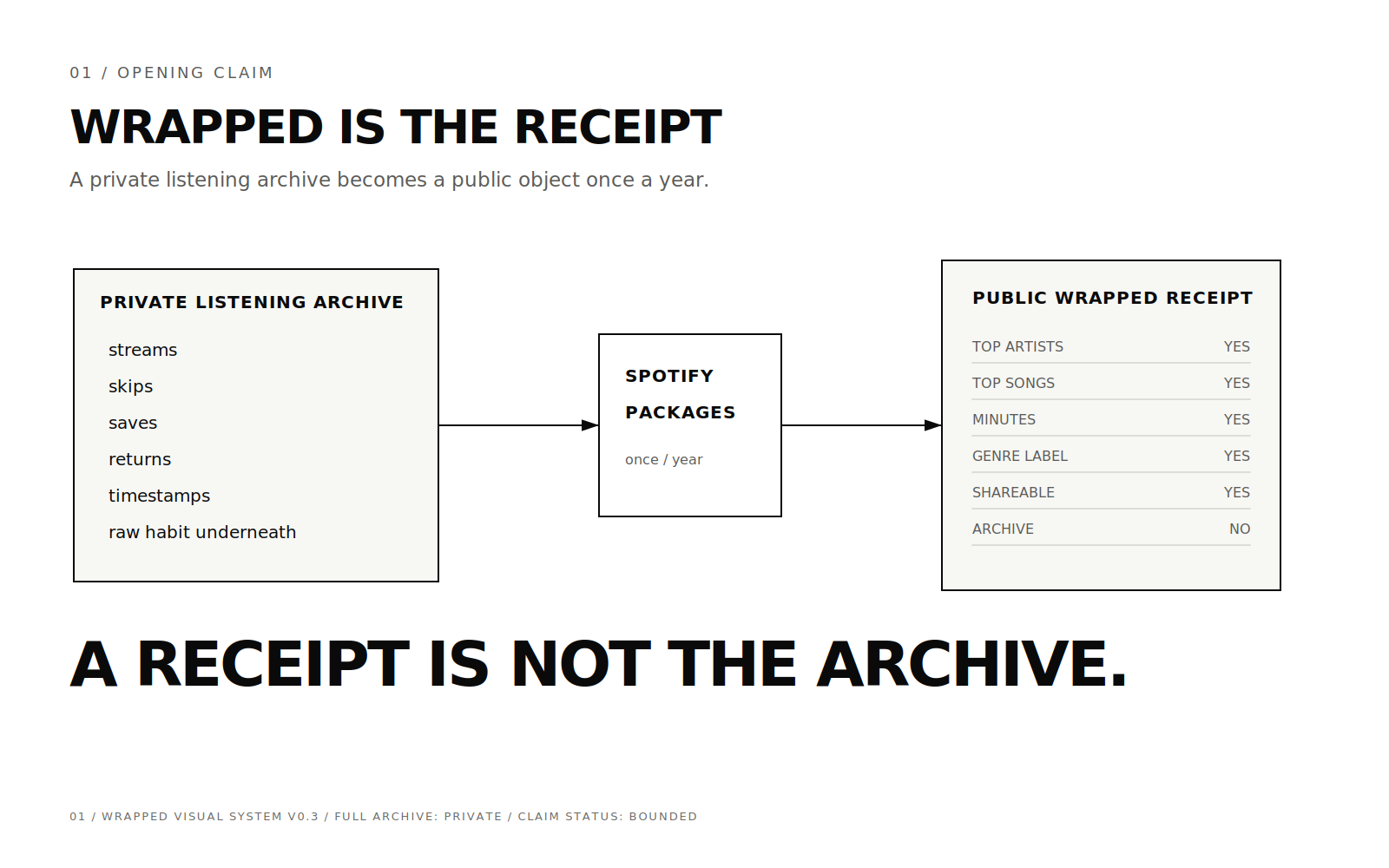
Wrapped shows the part of the archive Spotify chooses to package. It gives the share card, the top artists, the top songs, the minutes, the simple story. Useful. Fun. Clearly loved.
Wrapped is not wrong. It is just narrow.
But a receipt is not the archive.
The question that pulled this project forward was simpler:
what is sitting underneath the card?
Wrapped gives you the names. The archive knows the shape underneath.
I started with the old Wrapped playlists.
Not the cards. The actual playlists.
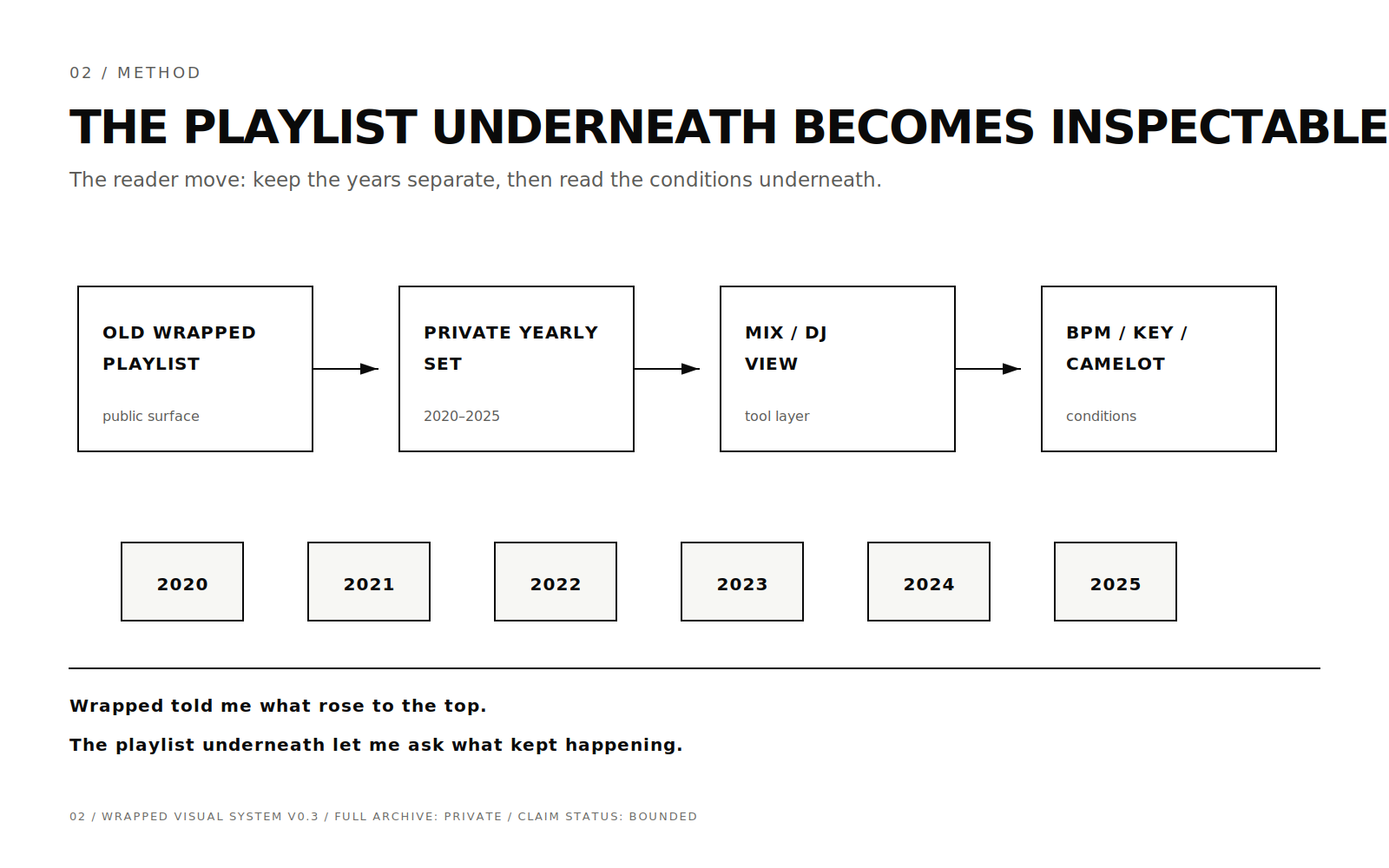
For each year from 2020 to 2025, I opened the old Wrapped / Top Songs playlist, hit the three dots, and saved it as a new private playlist.
Separate years. Separate containers.
That mattered. I did not want one blended memory of six years. I wanted to compare the shape of each year against the next.
Then I opened each private playlist in Mix, Spotify’s playlist transition tool, and hit Mix.
That was the trapdoor.
The surface story faded. The structure started to show.
The songs were no longer just titles and artists. Once the playlists moved into that mix view, they started to expose motion and position: BPM, key, and Camelot wheel placement.
A yearly playlist had turned into something inspectable.
This is the part that matters for the reader too. This did not start as a data science project. If the old playlists and mix tooling are available, the move is simple: search Wrapped, open the old playlist, save it privately, hit Mix, and look at what the playlist becomes when the songs are read as tempo and key instead of just memory.
Wrapped told me what rose to the top.
The playlist underneath let me ask what kept happening.
The first thing I noticed was not a favourite artist.
It was repetition on the wheel.
Certain Camelot zones kept showing up. Certain keys seemed to hold more of the archive than others. At first that was just a curiosity.
Why were so many songs clustering there?
Was it genre? Production style? Energy? Coincidence? Some private gravity in the songs I kept returning to?
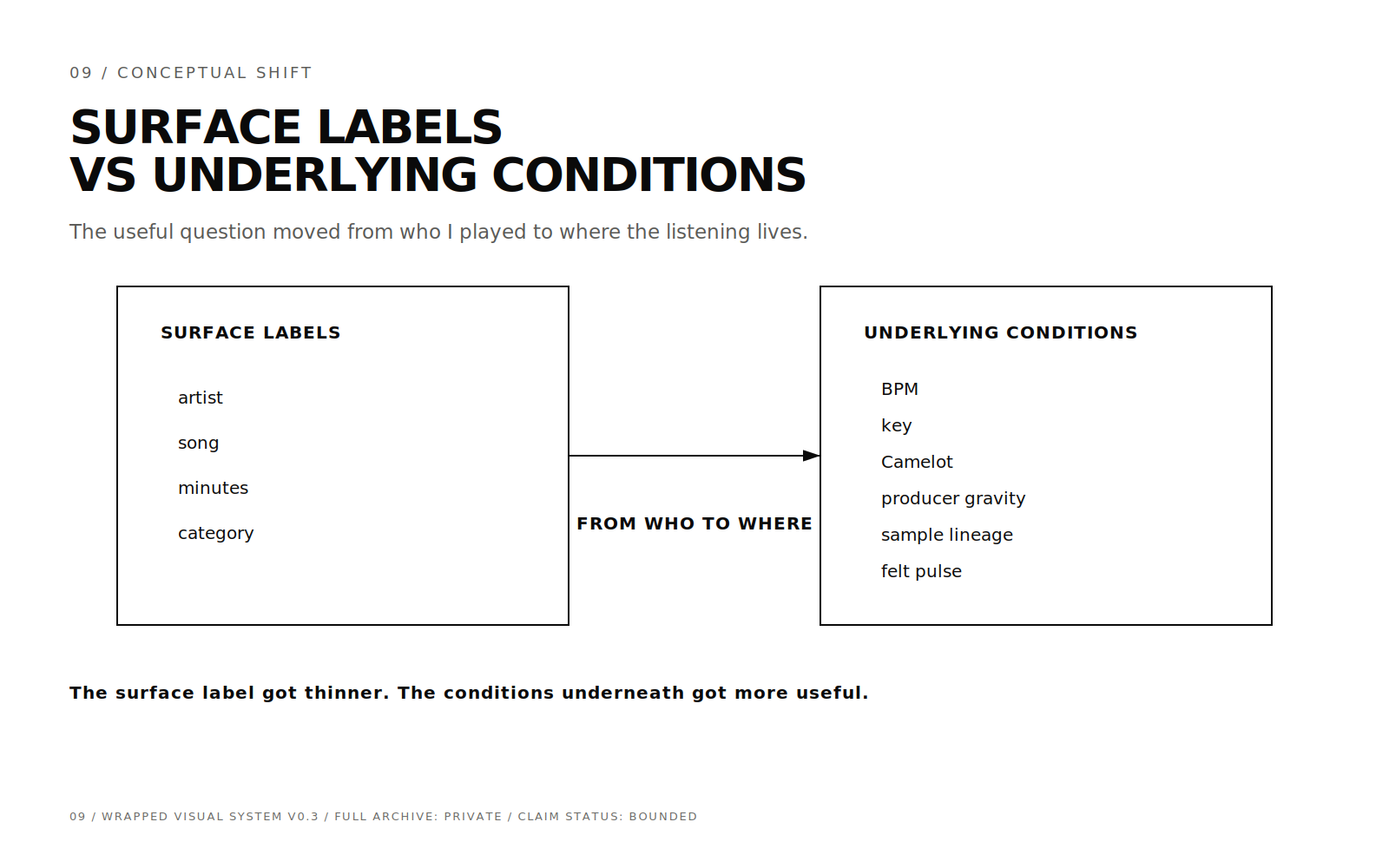
Once the wheel started repeating, I stopped asking, "who did I listen to?"
I started asking, "where does my listening live?"
That changed the project.
The playlist was no longer a way to remember what I played. It became a dataset I could question by year. Which zones repeated? Which keys disappeared? Did the archive drift, or did the same pockets keep pulling me back?
The repeated zones mattered in three ways.
First, they looked like a discovery signal. If the same BPM pockets and Camelot positions kept appearing, maybe the next useful recommendation was not just "more artists like this." Maybe it was an unknown song sitting inside the same conditions.
Second, they looked like a taste fingerprint. Not a personality test. Not a mood diagnosis. Just a structural trace of what I kept returning to.
Third, they made the years comparable. Because 2020, 2021, 2022, 2023, 2024, and 2025 were separate playlists, each year could be read against the others. One archive, six containers, different shapes.
That was the first useful break from Wrapped.
Wrapped compresses a year into a card.
The archive lets the year become a question.
Then the tempo started lying in an interesting way.
On paper, a lot of the songs looked fast. In my top-song analysis, the weighted average BPM across the top 120 sat around 123. The median BPM was 126.5.
But that was not how the music always felt.
When the tracks were read through felt pulse, the centre moved closer to 87 BPM.
The grid was faster than the body.
That difference mattered because it showed how quickly the same archive can tell a different story depending on the reader.
Raw BPM says one thing.
Felt pulse says another.
The song can move at 126 on the grid and still hit like 84 in the body.
That is where the archive became more than a list. It started to show layers: the measurable layer, the felt layer, the harmonic layer, the production layer.
A song was not only "by" an artist. It had a pocket. It had a key. It had a producer world. It had drums, samples, energy, and position.
The surface label was getting thinner.
The conditions underneath were getting more useful.
So if my archive had to write its own Wrapped card, it probably would not start with an artist.
It would say something much stranger:
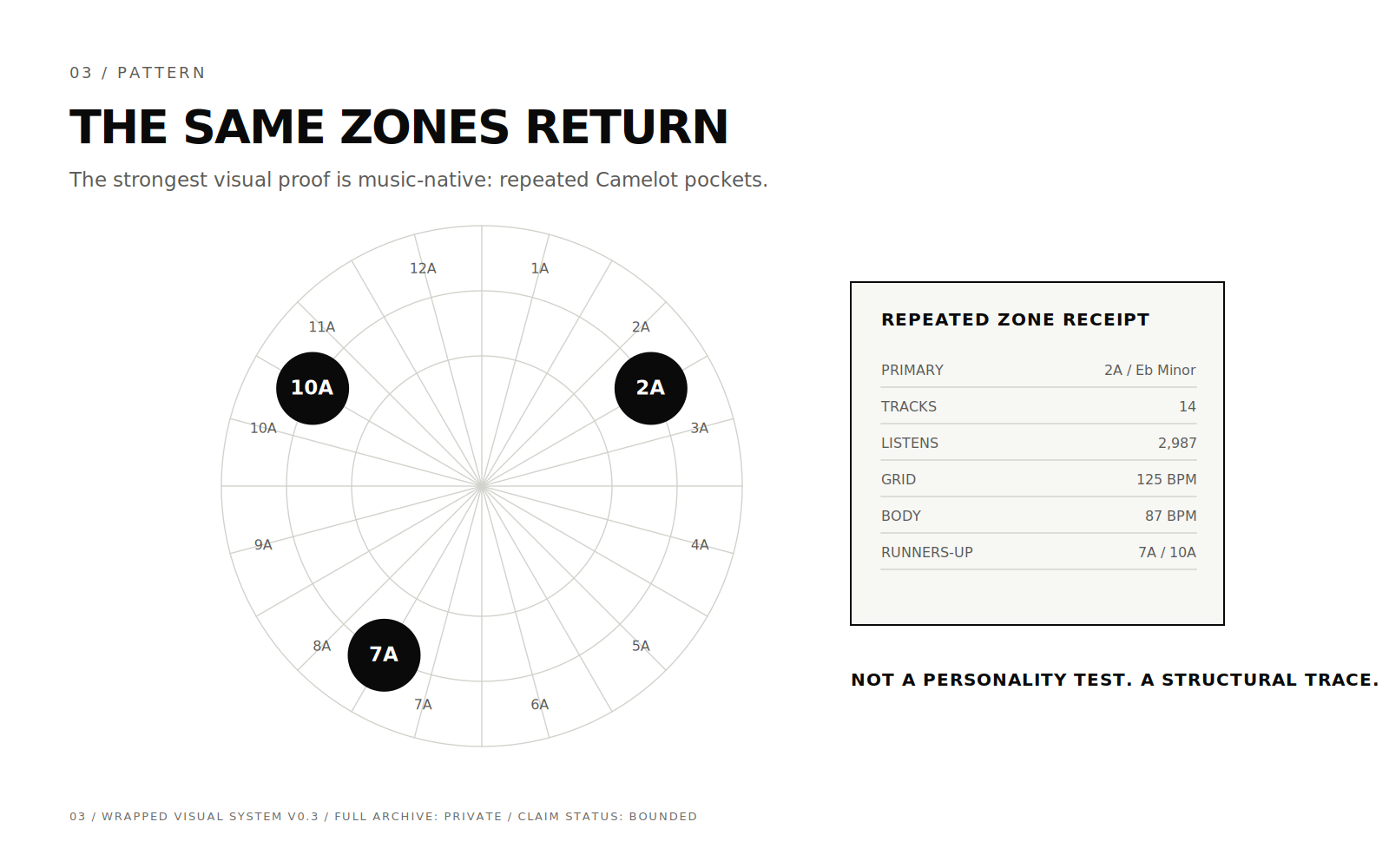
Congratulations. You are mostly 2A.
In my analysis, your strongest pocket was 2A / Eb Minor: 14 tracks, 2,987 listens, around 125 BPM on the grid and 87 BPM in the body.
Your runner-up zones were 7A / D Minor and 10A / B Minor.
Your top 120 tracks were heavily minor: 89 minor tracks against 31 major.
Your year was brought to you by mid-pocket motion, minor keys, Tay Keith, Metro Boomin, Dr. Dre, Boi-1da, and Wheezy quietly living under the floorboards.
This was not mood or personality. It was structural.
The conditions my taste kept creating when nobody was watching.
The archive is evidence, not identity.
Just a funnier receipt.
That is the joke on Wrapped.
Wrapped gives you the names that are easy to share: artists, songs, minutes, genres.
The archive gives you the weirder version: your key gravity, your pulse, your producer worlds, the repeat conditions your listening kept making when nobody was packaging it for Instagram.
Wrapped said: here are your top artists.
The archive said: you are 2A / Eb Minor with Tay Keith under the floorboards.
I trust the second one more than I expected.
This is where the joke becomes useful.
The discovery question is not finished. I have not proved that these zones can find the perfect unknown song. That part is still a future experiment.
But the direction is clear enough to name.
If the same keys, pulses, producers, samples, scenes, and BPM pockets keep appearing across years, the next music product should not treat me as a blank account.
A new platform should not have to start with "pick three artists you like."
A music app should not have to meet you as a stranger every time.
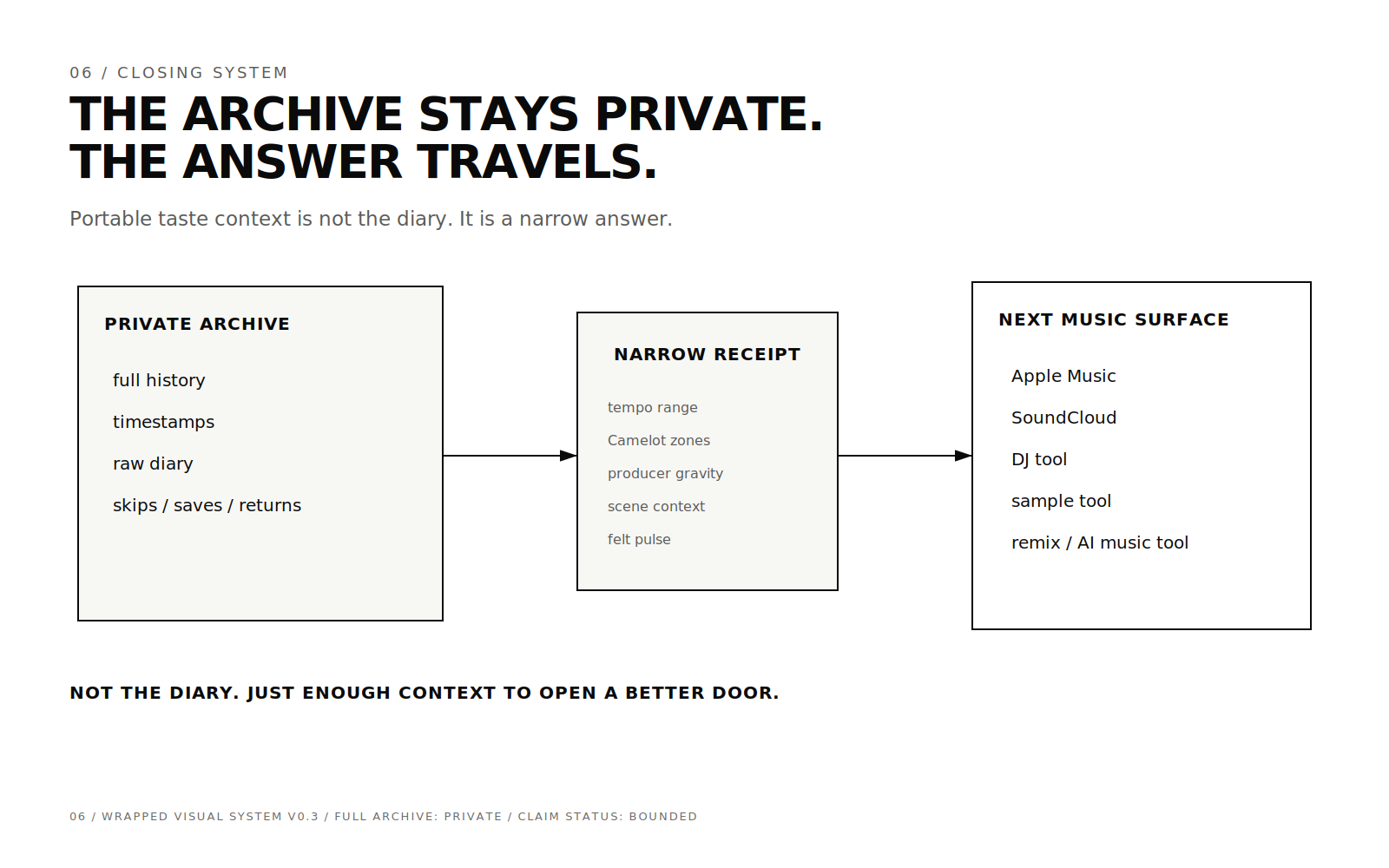
It should be able to read a narrow receipt from the archive and get up to speed.
Not the full listening history.
Not every timestamp.
Not the raw life underneath.
Just enough context to know where my taste already lives.
Portable taste context turns cold start into warm start.
A new music product could begin with context instead of onboarding.
That could matter on Apple Music or SoundCloud, where discovery starts again. It could matter to a DJ, where the question is not whether I know their name but whether my listening already sits inside their sound. It could matter inside sample, remix, and AI music tools, where the blank prompt is often the worst starting point.
The point is not that rights disappear. They do not.
The point is that creation, licensing, distribution, and discovery are all becoming more legible as products. More tools are making it easier to remix, generate, sample, edit, and play with sound without learning the old stack from zero.
That makes context more valuable, not less.
The archive should stop being only a mirror and start becoming an input.
As making music gets easier, knowing what to make for someone gets more valuable.
The question becomes what people are trained to notice.
Taste starts to look like a skill when it compounds over time.
Not skill in the credential sense. Skill as accumulation. The years of choosing, skipping, saving, replaying, digging, comparing, abandoning, returning. The private work of learning what you actually hear.
A useful archive can surface the forgotten SoundCloud upload, the producer alias, the Camelot drift, the remix chain, and the song you loved three months before the algorithm found it.
That is not just nostalgia.
It is context.
The phrase I keep coming back to is portable taste context.
Not a taste passport. Too official.
Not a public music résumé. Too performative.
Not a giant export of everything I ever played. Too exposed.
Portable taste context is smaller than that.
It is the answer from the archive that is safe enough to travel.
This listener has spent years in these tempo ranges.
This listener keeps returning to these Camelot zones.
This listener has producer gravity here.
This listener seems to recognise this scene, this pocket, this sample lineage, this kind of motion.
Enough to open a better door.
Not enough to hand over the diary.
That is still a music story first. The broader receipt layer for culture can come later.
For now, Wrapped is enough.
Wrapped proved people want the year in sound reflected back to them. My archive showed me the receipt can go deeper: not only artists and songs, but keys, pulse, producers, samples, scenes, and repeat conditions.
The next layer is not a bigger share card.
It is a way for the archive to produce context without becoming public.
The archive does not need to move for its answers to travel.
The archive stays private.
The answer travels.
Wrapped is the receipt.
Portable taste context is what comes next.